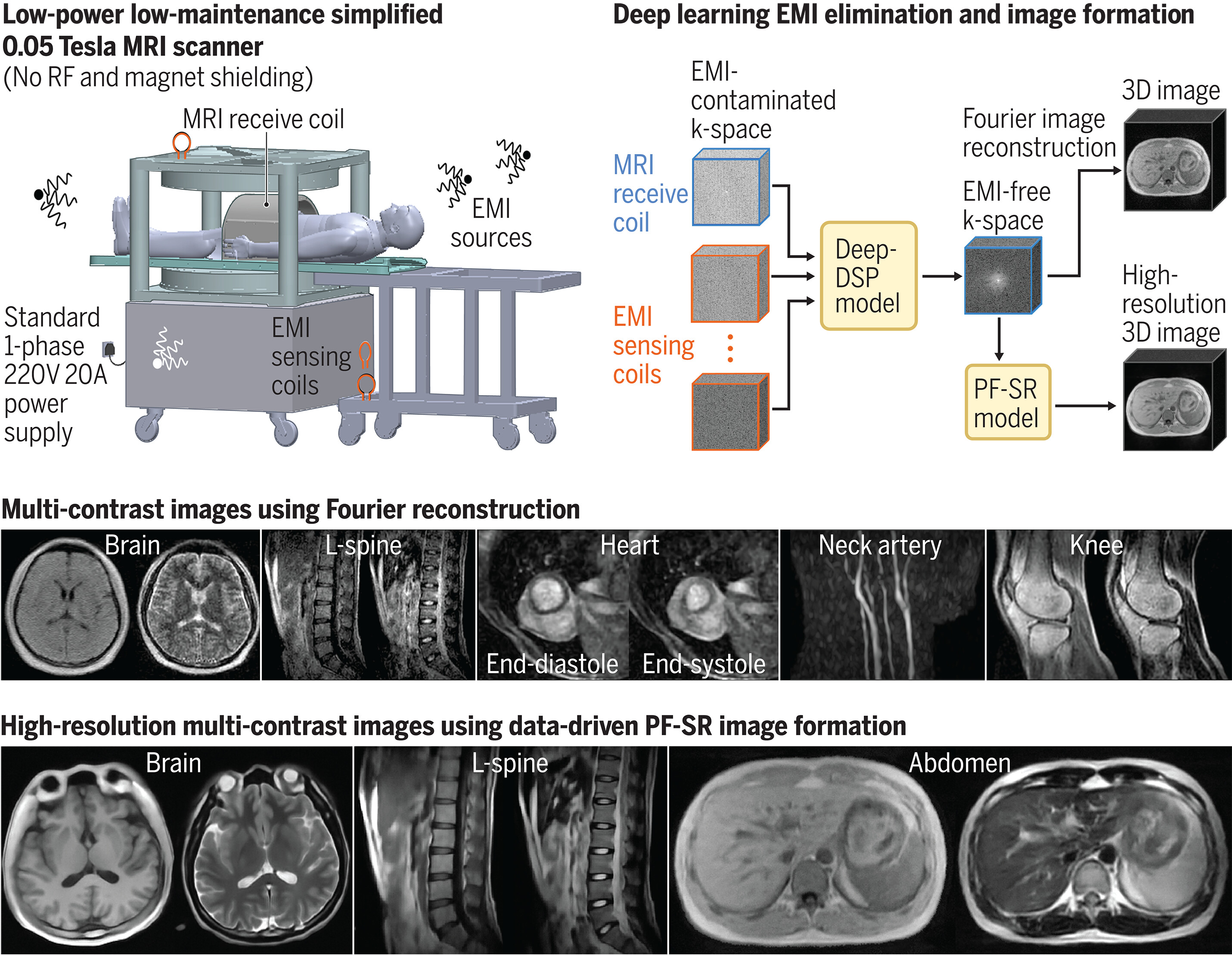
Whole-body magnetic resonance imaging at 0.05 Tesla
(Top) Prototype of a low-cost, low-power, compact, and shielding-free imaging system using an open 0.05 Tesla permanent magnet. It incorporates active sensing and deep learning to address EMI signals. (Middle) Typical images of various anatomical structures using conventional image reconstruction. (Bottom) High-resolution images using deep learning image formation by harnessing large-scale high-field MRI data.
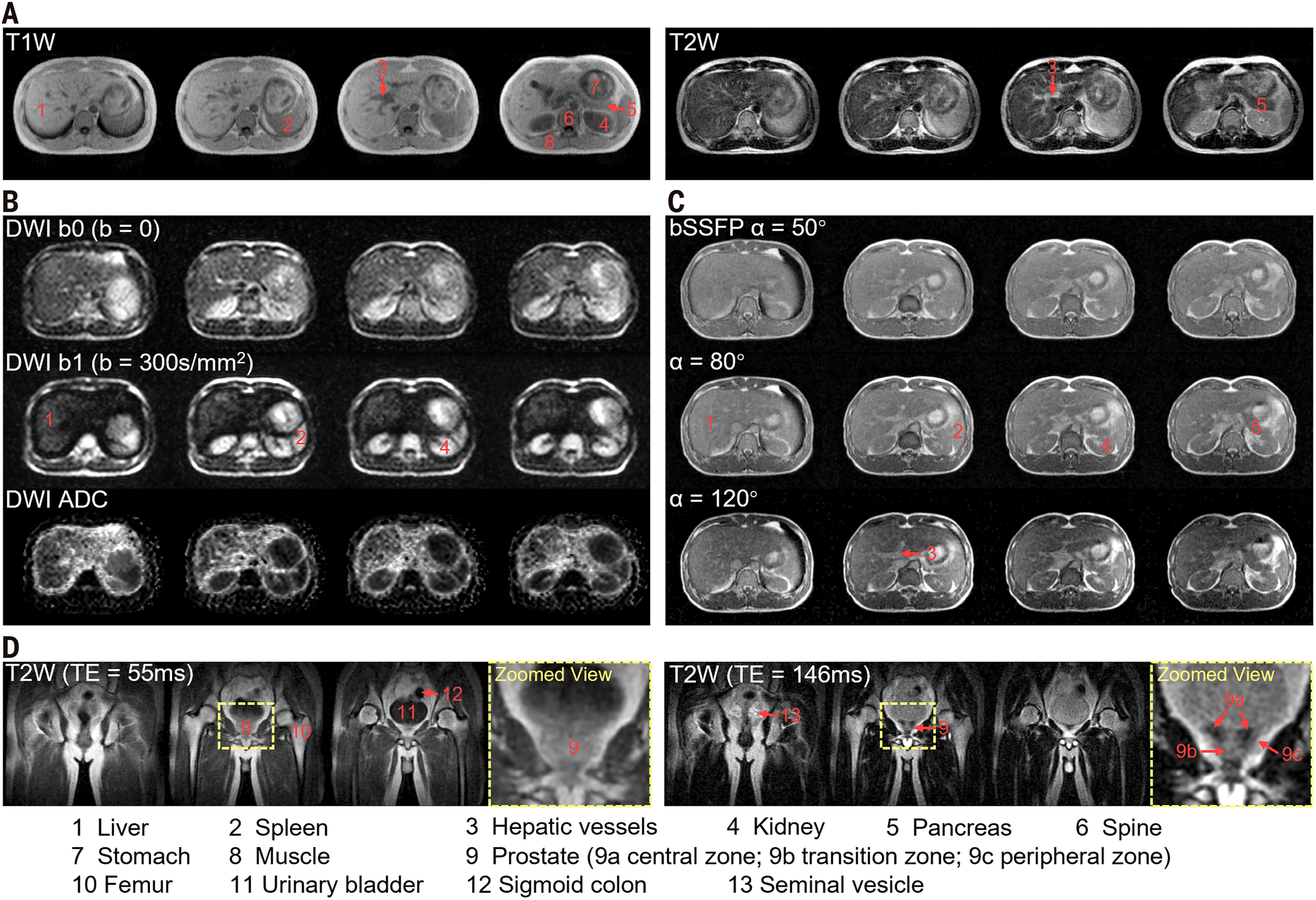
Whole-body magnetic resonance imaging at 0.05 Tesla
(A) Axial abdominal T1W and T2W images from a healthy volunteer (28 years old; male) using 3D SoS GRE (TR/TE/α° = 35 ms/5 ms/70°), and 3D SoS FSE (TR/TE/ETL = 700 ms/111 ms/18), respectively. (B) Axial abdominal DWI image set from a healthy volunteer (27 years old; male) using 2D EPI DWI (TR/TE = 1250 ms/84 ms). Images with b = 0 and 300 s/mm2 are shown, together with computed apparent diffusivity coefficient (ADC) map. (C) Axial abdominal 3D bSSFP images with varying tissue contrasts from the same volunteer as (B) using different flip angles (α = 50°, 80°, and 120° with TR = 8 ms). (D) Coronal pelvis T1W and T2W images from a healthy volunteer (28 years old; male) acquired using 3D FSE with TR/TE/ETL = 450 ms/55 ms/7 and 1500 ms/146 ms/23, respectively. For each imaging protocol, scan time was 8 min or less. Image resolution was ~2.3×2.3×8.0 mm3 (~2.3 mm in-plane resolution and 8.0 mm slice thickness) for T1W, T2W, and bSSFP images, ~5.0×5.0×8.0 mm3 for DWI images by acquisition. All images are displayed at reconstruction resolution 1×1×4 mm3.
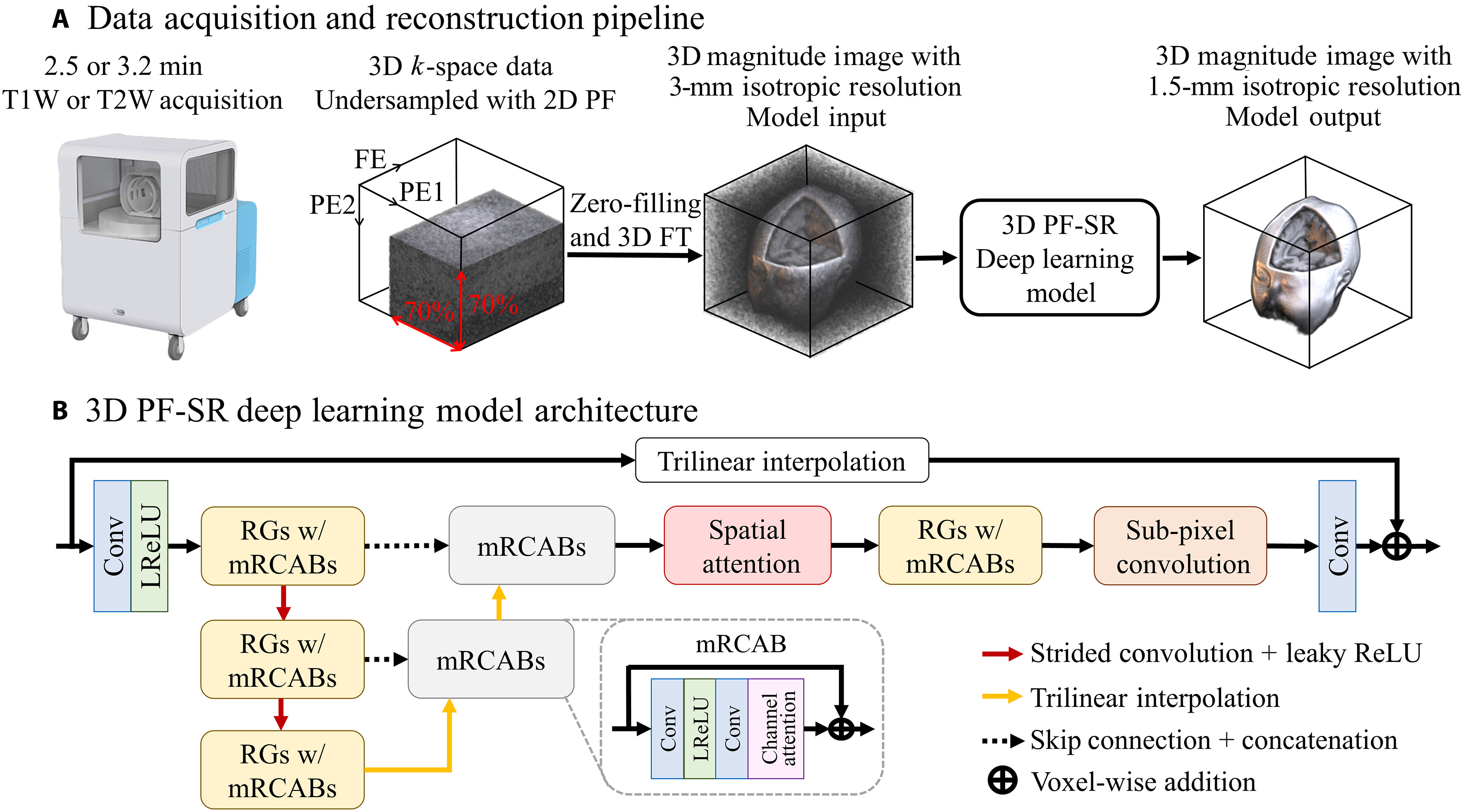
Deep learning enabled fast 3D brain MRI at 0.055 tesla
(A) Unlike typical ULF scans that acquire multiple NEXs, the proposed acquisition scheme acquires a single NEX, together with 2D PF sampling of a PF fraction of 0.7 in each of the two PE directions, in the FSE protocols for both T1W and T2W contrasts. The scan time is 2.5 and 3.2 min for T1W and T2W contrasts, respectively. The 3D data are then reconstructed by an end-to-end 3D DL model, which learns a residue between the high-resolution image and the interpolated low-resolution image. (B) The overall architecture of the DL 3D PF-SR reconstruction model. It is composed of residual groups (RGs) with modified residual channel attention blocks (mRCABs), multiscale feature extraction, spatial attention, and subpixel convolution. 3D convolution layer allows the effective extraction of 3D brain structural features. Multiscale feature extraction learns local features at the top-scale level and semiglobal features at the middle- to bottom-scale level. Spatial attention exploits the interspatial relationships by modulating the extracted features, which are then upsampled to the high-resolution space via subpixel convolution and transformed into a 3D image residue through a convolution layer. The final 3D image is formed by voxel-wise addition of the 3D image residue and the interpolated low-resolution image.
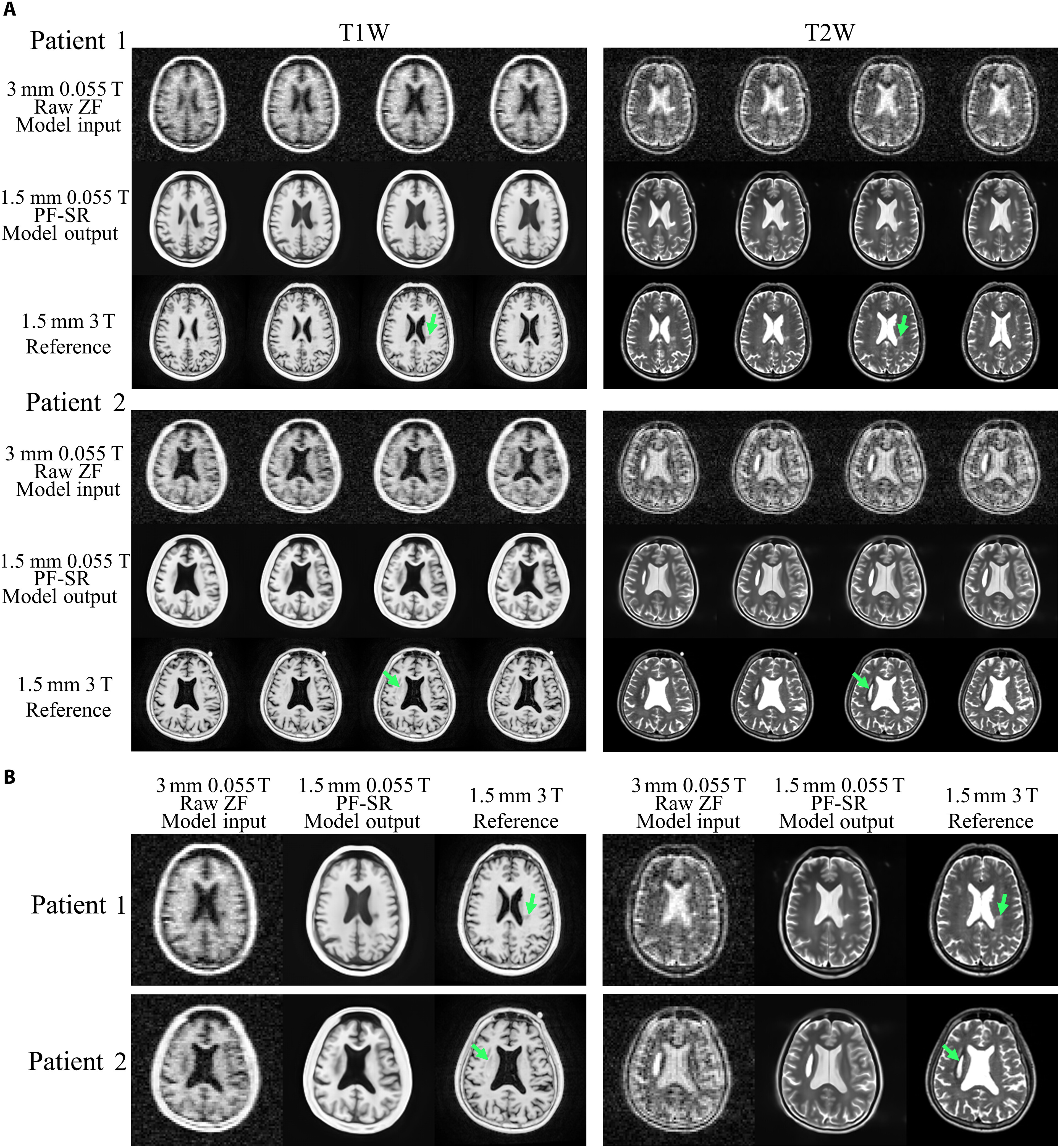
Deep learning enabled fast 3D brain MRI at 0.055 tesla
(A) Patient 1 was a 64-year-old male with chronic (~10 years) ischemic stroke. Patient 2 was a 53-year-old male with right basal ganglia hematoma due to (>2 months) hemorrhage. Four axial slices from PF-sampled low-resolution noisy raw images and PF-SR results are shown for each patient, as well as the corresponding 3 T reference images. (B) Enlarged views of single representative slices. Locations and boundaries of lesion reconstructed by PF-SR were supported by 3 T reference images.
Electromagnetic interference elimination via active sensing and deep learning prediction for radiofrequency shielding‐free MRI
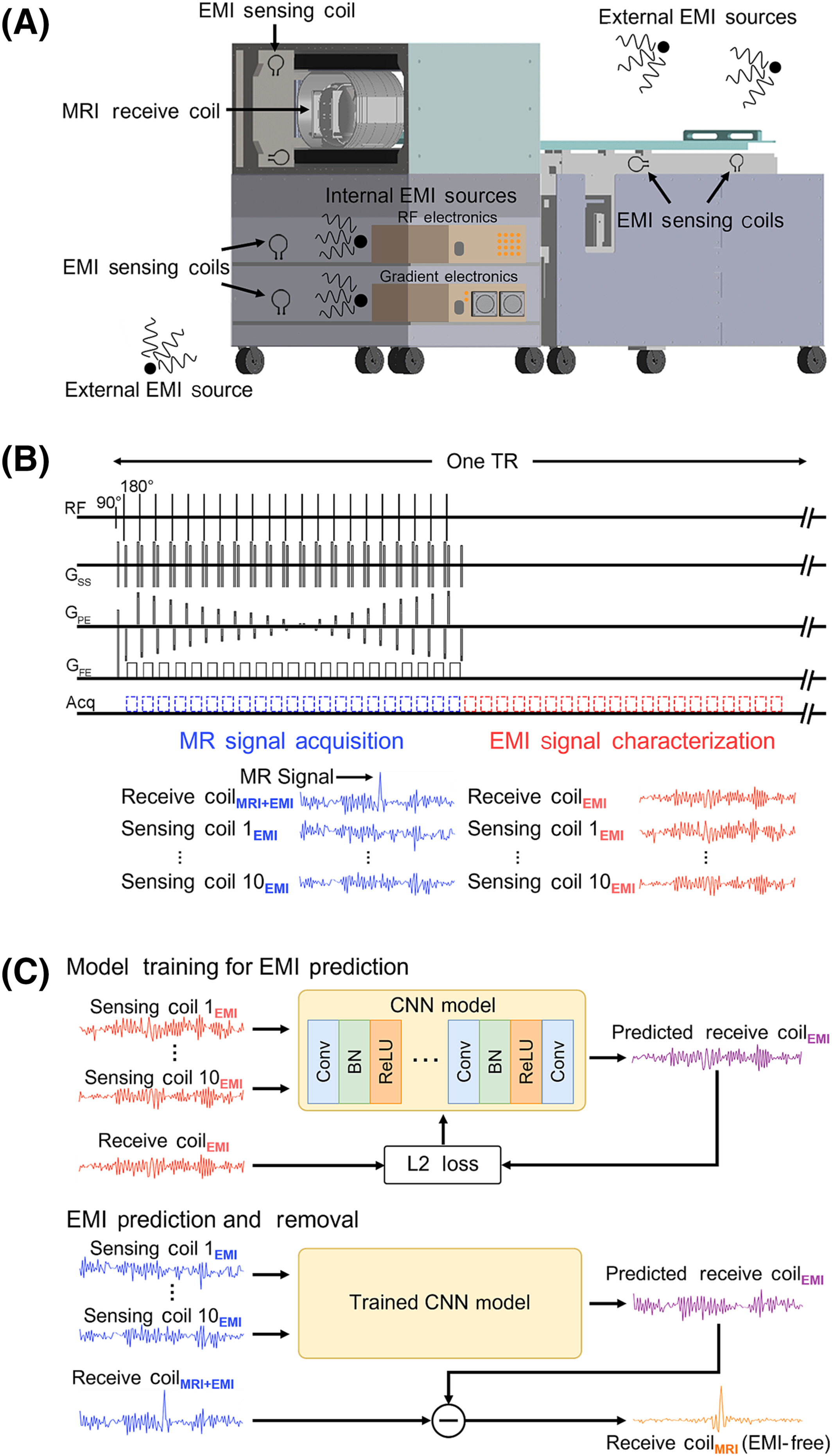
Active sensing and deep learning electromagnetic interference (EMI) prediction and cancellation on a low-cost ultralow-field (ULF) 0.055 T permanent magnet brain MRI scanner with no RF shielding, and with 2.32 MHz resonance frequency. (A) Multiple EMI-sensing coils are placed around and inside the scanner to actively detect EMI signals during MRI scanning. (B) Illustration of 3D FSE acquisition windows for MRI signal collection and EMI signal characterization. (C) A five-layer convolution neural network (CNN) model is first trained to establish the relationship between EMI signals received by the MRI receive coil and EMI-sensing coils within the second window, that is, the EMI signal characterization window. The model is then utilized to predict the EMI signal component detected by the MRI receive coil within the first window, that is, the conventional MRI signal acquisition window. BN, batch normalization; Conv, convolution; FSE, fast spin echo; ReLU, rectified linear unit; RF, radiofrequency.
Electromagnetic interference elimination via active sensing and deep learning prediction for radiofrequency shielding‐free MRI
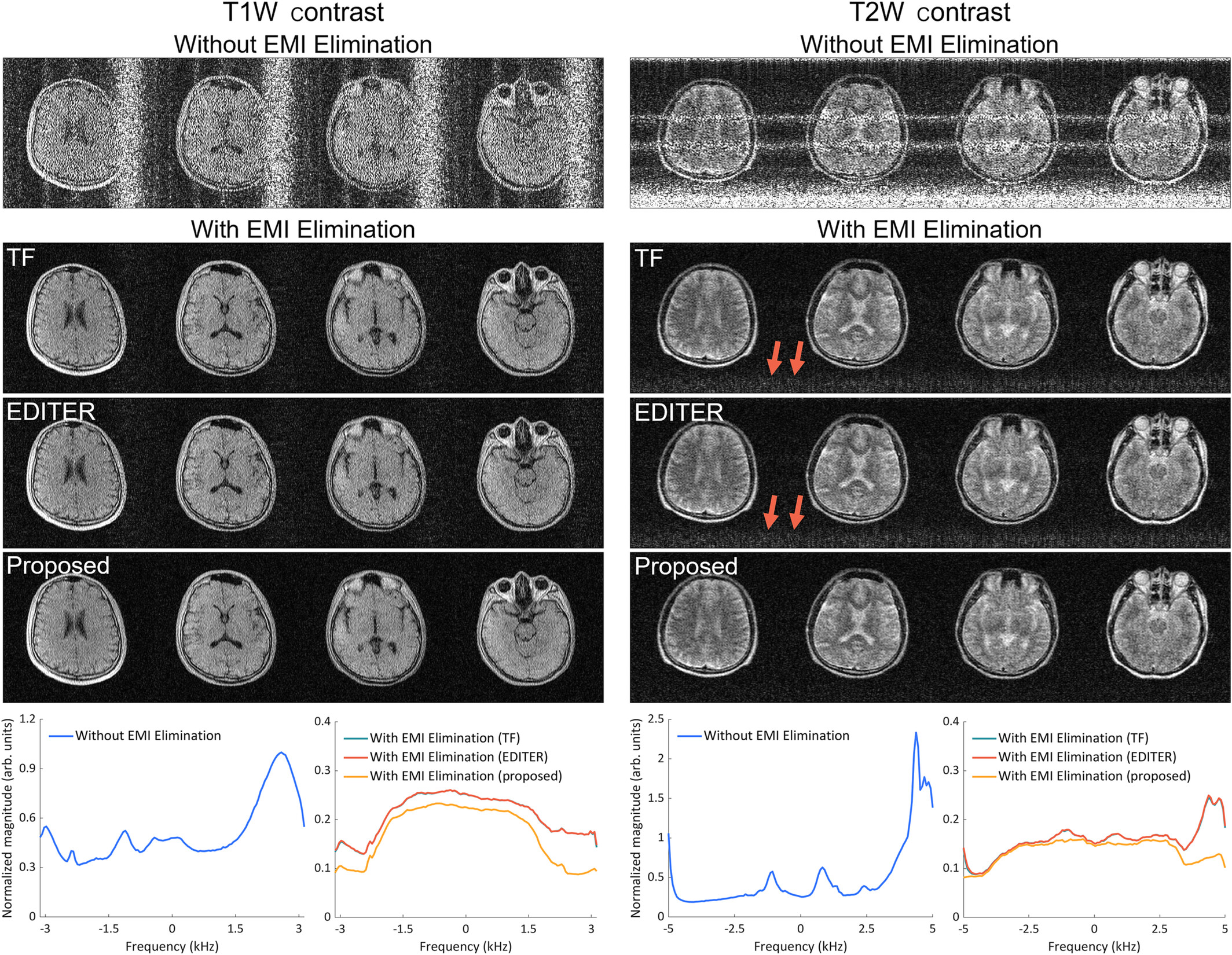
The proposed EMI elimination method versus existing methods for shielding-free 0.055 T human brain imaging with T1W and T2W contrasts. T1W and T2W brain datasets were acquired from two healthy adult subjects using 3D GRE and 3D FSE, respectively. All images are displayed at a spatial resolution of 1 × 1 × 5 mm3, while the acquisition resolution is approximately 2 × 2 × 10 mm3. The proposed deep learning EMI elimination strategy accurately predicted the EMI signal components in the MRI receive coil signals, leading to more effective EMI elimination than the existing TF and EDITER methods, as evident from both the image and spectral results. EDITER, external dynamic interference estimation and removal; EMI, electromagnetic interference; FSE, fast spin echo; GRE, gradient echo; TF, spectral domain transfer function.
A low-cost and shielding-free ultra-low-field brain MRI scanner
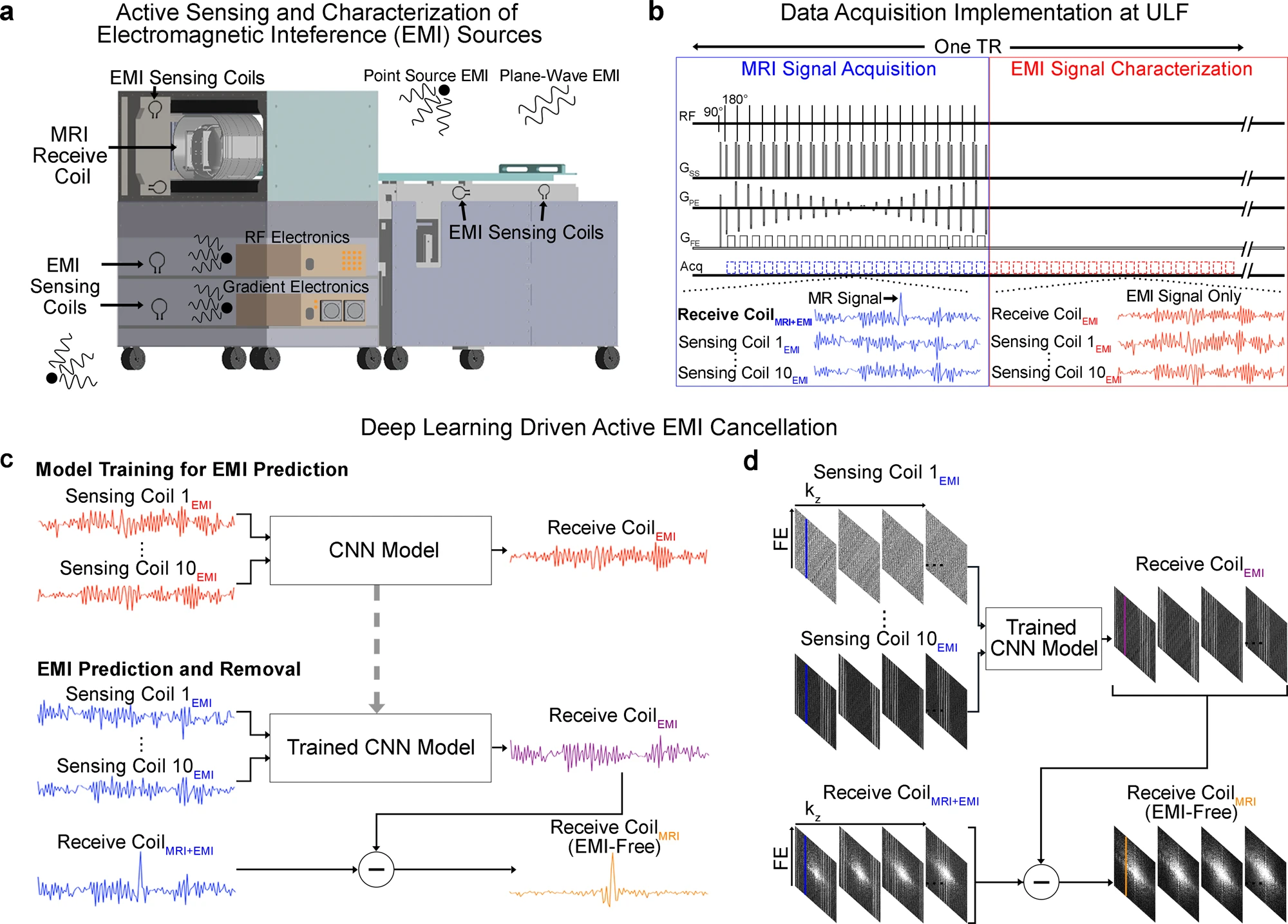
Ten small RF coils, i.e., EMI sensing coils, are strategically placed in the vicinity of transmit and receive RF coils, underneath the patient bed, and inside electronic cabinet to actively detect EMI signals only that are from both external environments and internal electronics. b Illustration of the 3D fast spin echo (FSE) pulse sequence data acquisition for both MRI signal collection and EMI signal characterization. Within each time of repetition (TR), data are acquired simultaneously by both MRI receive coil and EMI sensing coils across within two windows—the conventional MRI signal acquisition window and the EMI signal characterization window. Note that MRI signal is zero within EMI signal characterization window. c After each scan, a convolutional neural network (CNN) model is trained to establish the relationship between the EMI signals received by MRI receive coil and the sensing coils within EMI signal characterization window. The trained model can then predict the EMI signal component detected by the MRI receive coil within the MRI signal acquisition window from the simultaneously detected signals by EMI sensing coils for each frequency encoding (FE) line. The predicted EMI is subtracted from MRI receive coil signal to produce the EMI-free FE line. d This procedure is repeated for all individual FE lines before averaging and subsequent image reconstruction from the EMI-free k-space data.
A low-cost and shielding-free ultra-low-field brain MRI scanner
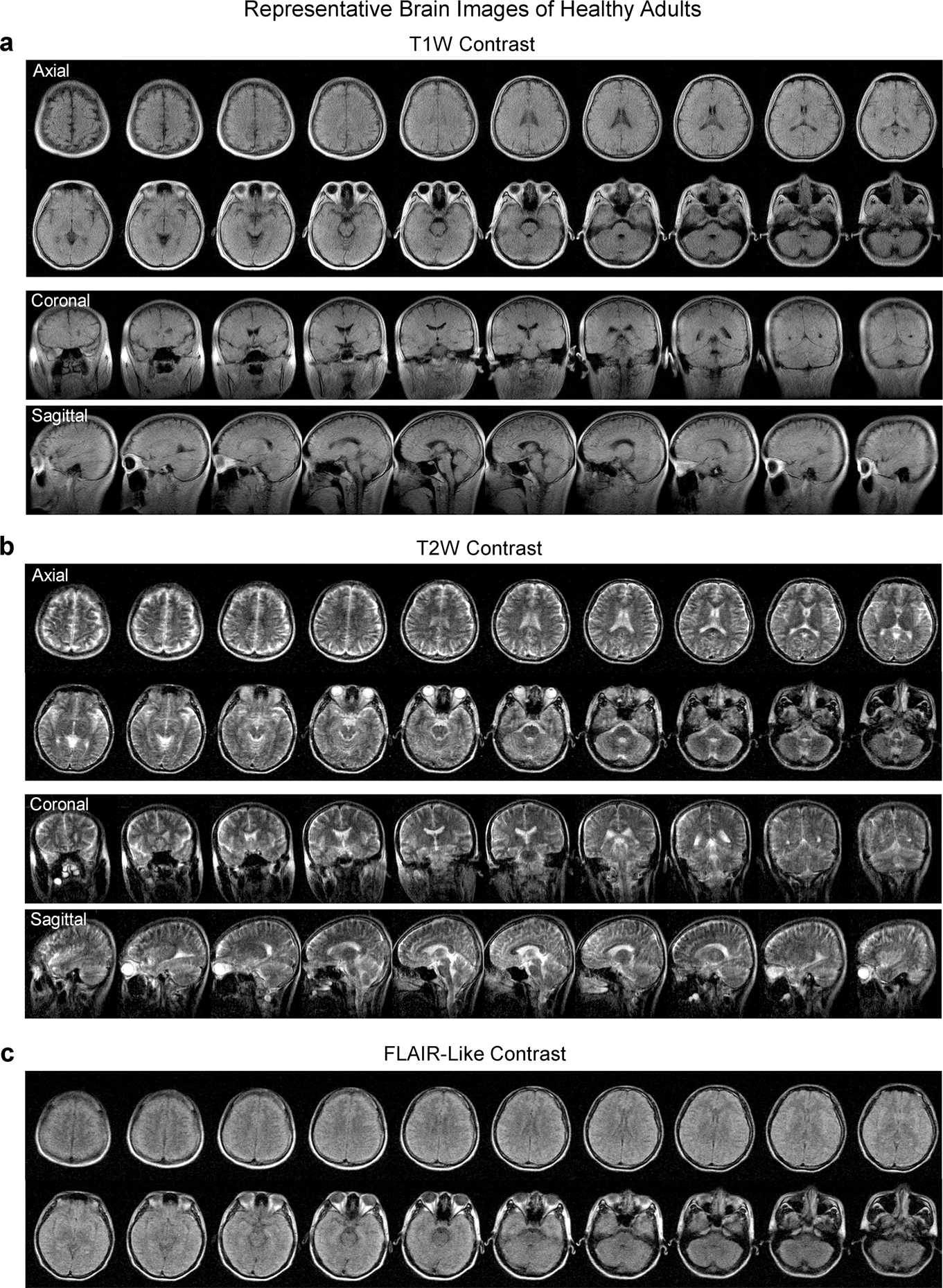
Whole-brain axial, coronal and sagittal sections of the brain were acquired at two common contrasts, namely a T1-weighted (T1W) images using the 3D gradient-echo sequence and b T2W using 3D fast spin echo sequence. c Whole-brain axial sections acquired with fluid-attenuated inversion recovery (FLAIR) like contrast using the 3D FSE sequence with short TR. Scan times are 5.5 mins, 7.5 mins and 7.5 mins for T1W, T2W and FLAIR protocols, respectively. All images are displayed at a spatial resolution of 1 × 1 × 5 mm3, while the acquisition resolution is approximately 2 × 2 × 10 mm3. The axial (23 yrs. old; male) and coronal/sagittal (23 yrs. old; male) images shown here were acquired from two healthy adults, respectively.