
HKU researchers are the first to identify
cancer stem cells that are responsible for
metastasis – the spread of cancer to other
parts of the body.
Their work focuses on colorectal cancer, the second most common cancer in the world and in Hong Kong. More than 50 per cent of patients develop metastasis even after adequate surgical removal of the primary tumour, and aggressive treatment of the metastasis usually fails: fewer than 10 per cent of patients with metastasis of colorectal cancer survive for more than five years. Researchers from the Departments of Medicine and Surgery have shown that cancer cells endowed with stem cell properties are the likely cause.
Their work focuses on colorectal cancer, the second most common cancer in the world and in Hong Kong. More than 50 per cent of patients develop metastasis even after adequate surgical removal of the primary tumour, and aggressive treatment of the metastasis usually fails: fewer than 10 per cent of patients with metastasis of colorectal cancer survive for more than five years. Researchers from the Departments of Medicine and Surgery have shown that cancer cells endowed with stem cell properties are the likely cause.
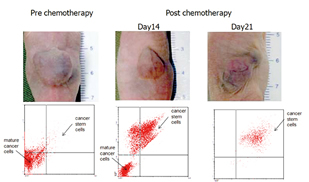
CHEMOTHERAPY LEADS TO
REDUCTION IN TUMOUR SIZE, BUT
ENRICHMENT OF CD26+ POPULATION
'Cancer stem cells' are like all other stem
cells in that they can produce further cells
like themselves (self-renewal) and also
differentiate to provide more mature cell
types. They are largely dormant and divide
infrequently within the tumour, while the
mature cells usually divide rapidly and make
up most of the tumour bulk.
"What happens with current therapies such as chemotherapy and radiotherapy is that they target and kill all the rapidly dividing cells, leaving behind the cancer stem cells," says Dr Roberta Pang, Research Assistant Professor of Medicine.
"Moreover, these cancer stem cells cannot be killed because like other stem cells, they are equipped with an intrinsic detoxifying capacity. Cancer stem cells that have not been eradicated can lead to a recurrence of the cancer because they are able to replenish the tumour mass through selfrenewal and differentiation.
"The re-established tumours are more enriched by cancer stem cells and become more resistant to conventional therapies, which accounts for the more aggressive and resistant nature of recurrent tumours."
This pattern parallels what's often seen in clinical settings. "When patients are treated with chemotherapy, you may observe tumour shrinkage initially and the disease will seem to resolve. However, in a substantial number of patients, recurrence or a distant metastasis will then develop and the recurrent tumour usually becomes much more aggressive and resistant to conventional chemotherapeutic agents. We believe the reason for this recurrence and metastasis is the failure to effectively target the cancer stem cells," Dr Pang says.
Alarming as that may sound to patients, the research offers hope of detecting the risk of metastasis at an early stage.
A new marker was found that detects cancer stem cells in the blood even when the disease is at an early stage, which can accurately predict the likelihood of metastasis. (Current monitoring consists of a blood test that is not accurate in detecting cancer recurrence and cannot detect metastasis.) This will alert doctors to be extra vigilant in monitoring.
"Patient compliance is also an issue. Some patients may attend follow-up for only one or two years and think the disease is cured. So it's important to have a marker that can accurately predict their likelihood of metastasis," Dr Pang says.
The HKU team has begun testing different molecular targeting drugs that can specifically target these cancer stem cells, and is conducting similar studies of cancer stem cells in gastric and liver cancer.
The findings on colorectal cancer were featured on the cover of the June issue of Cell Stem Cell, the leading publication on stem cell research.
"What happens with current therapies such as chemotherapy and radiotherapy is that they target and kill all the rapidly dividing cells, leaving behind the cancer stem cells," says Dr Roberta Pang, Research Assistant Professor of Medicine.
"Moreover, these cancer stem cells cannot be killed because like other stem cells, they are equipped with an intrinsic detoxifying capacity. Cancer stem cells that have not been eradicated can lead to a recurrence of the cancer because they are able to replenish the tumour mass through selfrenewal and differentiation.
"The re-established tumours are more enriched by cancer stem cells and become more resistant to conventional therapies, which accounts for the more aggressive and resistant nature of recurrent tumours."
This pattern parallels what's often seen in clinical settings. "When patients are treated with chemotherapy, you may observe tumour shrinkage initially and the disease will seem to resolve. However, in a substantial number of patients, recurrence or a distant metastasis will then develop and the recurrent tumour usually becomes much more aggressive and resistant to conventional chemotherapeutic agents. We believe the reason for this recurrence and metastasis is the failure to effectively target the cancer stem cells," Dr Pang says.
Alarming as that may sound to patients, the research offers hope of detecting the risk of metastasis at an early stage.
A new marker was found that detects cancer stem cells in the blood even when the disease is at an early stage, which can accurately predict the likelihood of metastasis. (Current monitoring consists of a blood test that is not accurate in detecting cancer recurrence and cannot detect metastasis.) This will alert doctors to be extra vigilant in monitoring.
"Patient compliance is also an issue. Some patients may attend follow-up for only one or two years and think the disease is cured. So it's important to have a marker that can accurately predict their likelihood of metastasis," Dr Pang says.
The HKU team has begun testing different molecular targeting drugs that can specifically target these cancer stem cells, and is conducting similar studies of cancer stem cells in gastric and liver cancer.
The findings on colorectal cancer were featured on the cover of the June issue of Cell Stem Cell, the leading publication on stem cell research.