

Dr Barbara Chan, Associate Professor
of Mechanical Engineering and her team
are developing stem cells into tissues for
transplant, such as cartilage, bone and intervertebral
discs. They wrap the stem cells in
tiny collagen micro-spheres, which provide
a structure for the cells to develop in, and
subject them to biological and mechanical
signals to encourage them to differentiate, or
grow, into the desired cell type.
"Stem cells are naïve cells," she says. "They don't perform any specialized function. You have to give them the appropriate 'educational programme' so they can be induced to differentiate into a particular functioning cell, such as a cartilage cell."
"Stem cells are naïve cells," she says. "They don't perform any specialized function. You have to give them the appropriate 'educational programme' so they can be induced to differentiate into a particular functioning cell, such as a cartilage cell."
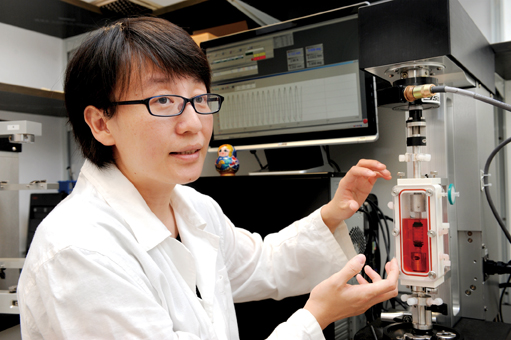 |
| Dr Barbara Chan and a bioreactor. |
The 'programme' in this case involves
introducing growth factors into the threedimensional
micro-sphere environment and
subjecting it to mechanical loading through
a bioreactor. The bioreactor is a specialized
equipment that uses physical forces such
as tension, torsion and compression to
train stem cells to differentiate into tendons,
ligaments or inter-vertebral disc cells.
In the example of cartilage cells, Dr Chan and her team were able to show that the stem cells entrapped in the microsphere underwent biological changes and developed the function, shape and structure of cartilage cells. The cartilage cells deposited new matrices in the microspheres, leading to significant mechanical changes such as increased stiffness, so that they came to resemble native cartilage tissue.
To test whether the cartilage-like tissue helped in cartilage repair, the scientists transplanted thousands of the tiny microspheres into cartilage defects in rabbits, to make up one mass of tissue. While the study is not yet complete, the rabbits receiving the transplants have shown encouraging signs of repair to their cartilage, bone and the interface in between, unlike those left to self-heal. The stem cells had come from the rabbits themselves so there is no chance of rejection.
Dr Chan is now trying to secure funding to continue her studies with larger animals on the way to hopefully developing an application for humans.
"Our ultimate goal is to understand all the factors that can influence stem cell differentiation," she says.
In the example of cartilage cells, Dr Chan and her team were able to show that the stem cells entrapped in the microsphere underwent biological changes and developed the function, shape and structure of cartilage cells. The cartilage cells deposited new matrices in the microspheres, leading to significant mechanical changes such as increased stiffness, so that they came to resemble native cartilage tissue.
To test whether the cartilage-like tissue helped in cartilage repair, the scientists transplanted thousands of the tiny microspheres into cartilage defects in rabbits, to make up one mass of tissue. While the study is not yet complete, the rabbits receiving the transplants have shown encouraging signs of repair to their cartilage, bone and the interface in between, unlike those left to self-heal. The stem cells had come from the rabbits themselves so there is no chance of rejection.
Dr Chan is now trying to secure funding to continue her studies with larger animals on the way to hopefully developing an application for humans.
"Our ultimate goal is to understand all the factors that can influence stem cell differentiation," she says.